

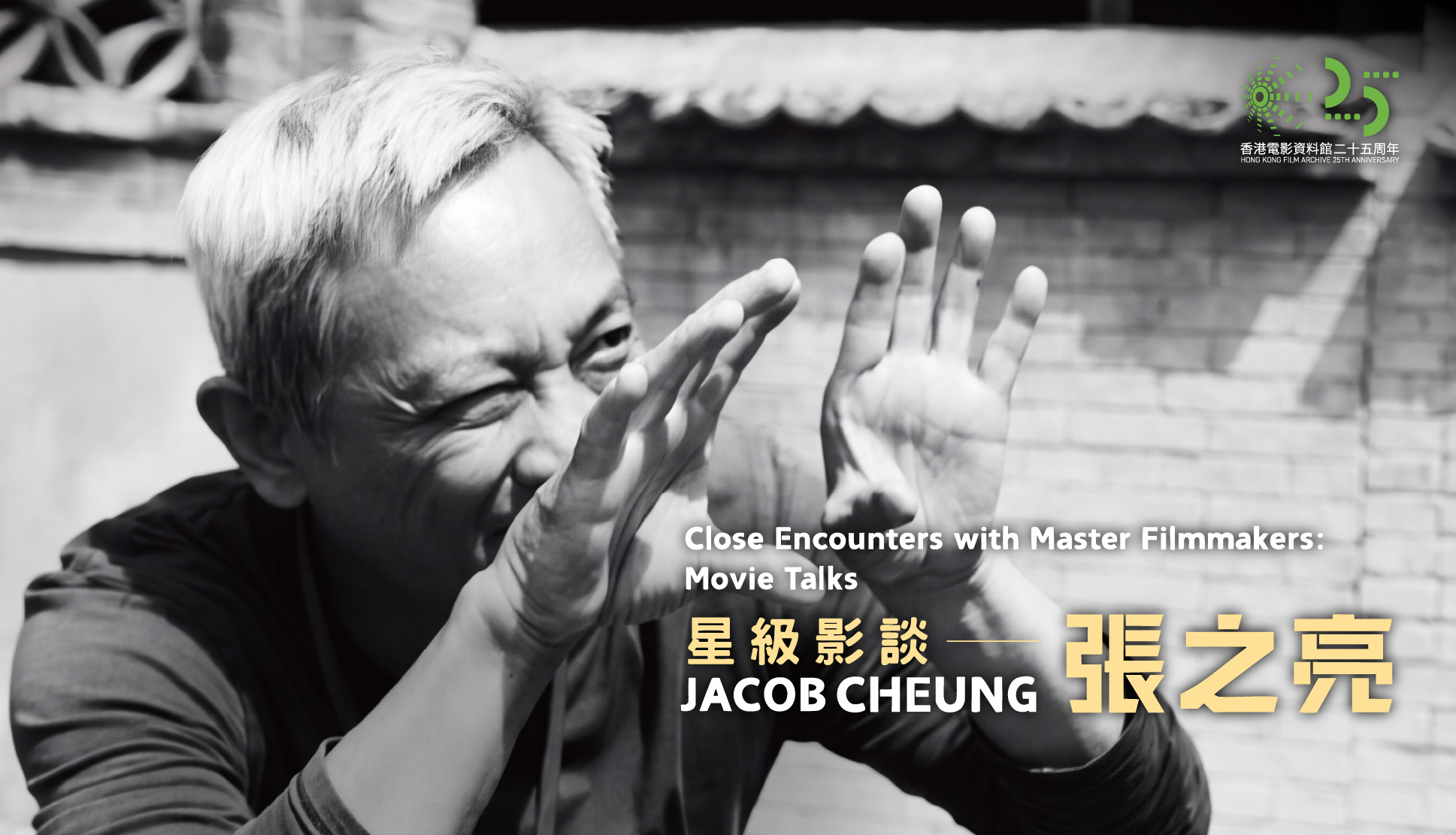
To celebrate its 25th anniversary, the Hong Kong Film Archive is presenting three editions of ‘Close Encounters with Master Filmmakers—Movie Talks’ series this year. Each edition is curated by a Hong Kong Film Awards-winning director, who personally selects the films and plans the programme. The final edition spotlights director Jacob Cheung and his filmmaking journey.
Cheung developed a strong interest in acting from a young age. In 1981, he successfully auditioned for TVB’s 10th Artiste Training Class, where his classmates included Andy Lau, Tony Leung Ka-fai, and Carrie Ng. After graduating, he followed the advice of his mentor Liu Fang-kang, giving up a career as an actor to work behind the camera as an assistant director.
From 1983 to 1985, Cheung worked as a production manager at Cinema City, then as an associate producer at Bo Ho Films. While at Bo Ho, he finally realised his dream of directing with Lai Shi, China’s Last Eunuch (1988). Sammo Hung took charge of the production, serving as producer and also appearing in the role of opera troupe leader. He brought in Lam Ching-ying, Wu Ma, and Andy Lau as supporting cast. For Bo Ho Films, best known for its action repertoire, this became a rare but important entry in their filmography: a biopic and historical epic. It achieved box office success and critical acclaim, earning four Hong Kong Film Award nominations including Best Director, marking brilliant start to Jacob Cheung’s career as a director.
In Beyond the Sunset (1989), amidst local concerns about Hong Kong’s impending handover, Cheung portrays a twilight romance that weaves together themes such as the gap in generational values and the issue of migration. He enjoyed great freedom in his subject matter, script development, and casting, allowing his humanistic approach and signature insight into social realities to gradually take shape. The film went on to win Best Picture and Best Screenplay at the Hong Kong Film Awards.
As the film industry suffered a state of decline in the 1990s, Cheung founded Filmagica Productions Limited and directed Goodbye Hero (1990) and Lover’s Tear (1991). He then returned to his social realism roots with Cageman (1992). After hands-on visits and research on cagehomes in Sham Shui Po, he developed a story focused on the grassroots population living in such horrifying conditions — one of the very few commercial productions of the time to discuss Hong Kong’s housing problems. It earned much critical acclaim and won Best Film, Best Director, Best Screenplay, and Best Supporting Actor at the Hong Kong Film Awards. Cheung became recognised as a major talent in Hong Kong social realism films, bucking contemporary commercial trends that largely focused on wuxia and action films.
Cheung never stopped working despite increasingly challenging conditions in the film industry. In 1993, he established Simpson Performance & Productions Co., Ltd. and produced Huang Jianxin’s Back to Back, Face to Face (1994), Chang Tso-chi’s Midnight Revenge (1994), and Derek Chiu Sung-kee’s Mr. Sardine (1994), opening up new connections and opportunities across the film industries of the Strait and Hong Kong.
The same year, he joined United Filmmakers Organization (UFO) as director and producer, making films such as Always on My Mind (1993), The Returning (1994), Whatever Will Be, Will Be (1995), Intimates (1997), and Yesterday You, Yesterday Me III (1997). Among them, Intimates stood out for its portrayal of the independence and values of women of two generations, continuing themes Cheung began exploring in Beyond the Sunset. Always on My Mind, on the other hand, sharply satirized the local news media and the sense of crisis facing middle-class families in Hong Kong.
In 1998, amidst further decline in the film industry, Cheung, Derek Yee Tung-sing and about twenty other filmmakers formed Creative Alliance, proposing to produce creative projects on low budgets. Ultimately, only Cheung seized the opportunity to make The Kid (1999). In a direct look at Hong Kong after the financial crisis, he created a delicate story of familial love. Leslie Cheung generously agreed to play the lead role by accepting a nominal fee of $1. Three years later, in 2001, while the city was still in recession, Cheung directed Midnight Fly, expressing the haplessness and frustrations of women navigating difficult journeys in life. This was Cheung’s farewell film before moving to Chinese Mainland to further his career. It also features one of Anita Mui’s greatest performances in the latter part of her career.
Although Cheung has not fulfilled his dream of being an actor, he consistently drew outstanding performances from his cast, among them Fung Bo-bo, Cecilia Yip, Josephine Siao Fong-fong, Carina Lau Ka-ling, Charlie Yeung, Theresa Lee, Carrie Ng, Anita Mui, Max Mok Siu-chung, Liu Kai-chi, Wong Ka-kui, Kuk Fung, Ti Lung, and Leslie Cheung. Cheung’s love of acting is evident through the way he has supported and nurtured his actors’ performances by giving them creative space to develop and construct their characters.
An astute observer of both individuals and social relations, Cheung has consistently maintained a sense of humanism and care in his films, no matter whether they are social realist works, dramas, or romances. The way people protect, care, and make sacrifices for each other form the core values of his filmography. Over more than two decades in Chinese Mainland, he directed the big-budget comic-book adaptation A Battle of Wits (2006), as well as the futuristic and fantastical Rest on Your Shoulder (2011). The latter film in particular develops from a tale of romantic love into a meditation on broader issues of environmental protection and global concerns—an encapsulation and reflection of Cheung’s constant and steadfast interest in the themes of human kindness, truth and beauty.