

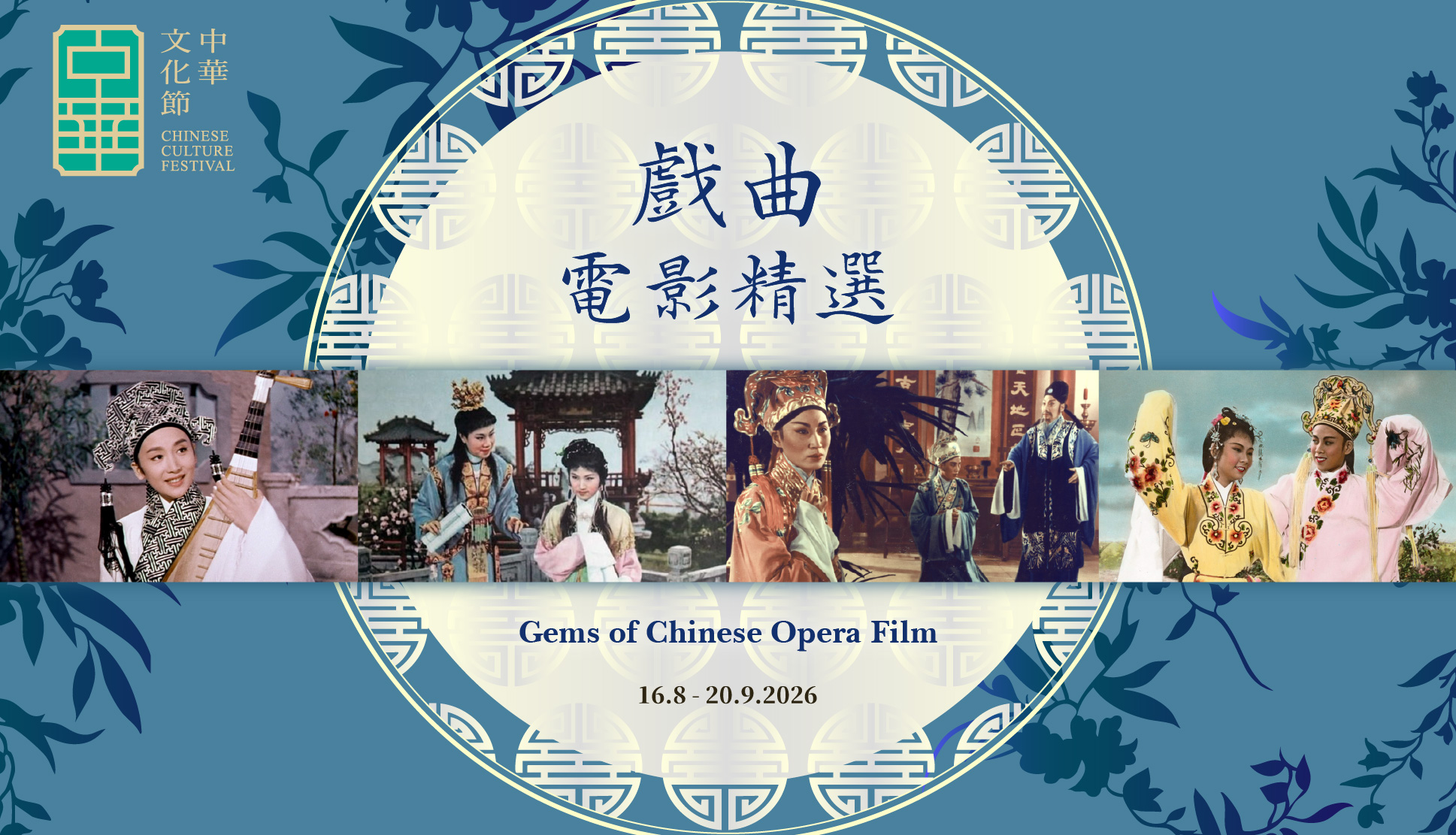
The Chinese Mainland introduced a series of Chinese opera reforms in the 1950s, including a drive to modernise and better organise its materials. Much of the classical Chinese opera repertoire had previously relied solely on oral traditions for preservation and transmission, but were now systematically recorded. The reforms also aimed to revise and improve the libretti, and enhance the level of stage performance so as to make sure that these opera traditions could align with modern standards. Against this backdrop, a great number of accomplished works emerged during this period, including the Cantonese opera The Lost Kite, the Chaozhou opera The Tale of So Luk Neung, and the Yue operas Bride Hunter and Dream of the Red Chamber. These brilliant stage works captured the attention of Chinese Mainland film studios, who subsequently adapted them for the big screen. At the same time, their counterparts in Hong Kong also learned from the Chinese opera culture, and boldly incorporated elements of these works into their films, for example Great Wall’s decision to feature Hong Kong stars onscreen alongside the voice work of Mainland maestros in the pioneering Yue opera film Bride Hunter (1961). Chinese opera films thus became one of the key genres in 1950s and 60s Hong Kong cinema, and was beloved by local and overseas audiences alike. The four classic works featured in this programme are a perfect showcase of the timeless allure and diverse charms of traditional Chinese opera, from its poetic lyricism to the refined beauty of its costumes.
We have invited renowned stage director and playwright Edward Lam to host two post-screening talks. An experienced veteran of adapting literary classics for the modern stage, Lam will share fresh and original insights about the two Yue opera films.
Yue Opera in the ‘Hall of Mirrors’
Edward Lam
My relationship with Yue opera has been complex, shaped by moments of both joyful encounter and lonely sorrow.
Let’s begin with the joy.
In my youth, we had a 14-inch black-and-white television set at home. Many films vanished after a single broadcast, but thanks to that television, I managed to watch them all. Just thinking of it brings back memories of The Return of the Condor Heroes (1960), starring Patrick Tse Yin and Nam Hung; Seven Fairies (1963) with Chiang Ching and Rong Rong; and Bride Hunter (1961).
It was this film, Bride Hunter, that showed me for the first time that ‘gender is a performative act’—though, of course, that concept had not been popularised back then. This beautiful, statuesque woman in period costume on the small screen, once she started moving, revealed ‘himself’ to be a debonair young gentleman. How could I make sense of this: was my heart beating so for her, or for him?
In the film, his name is Zhou Wenbin, a handsome scholar who disguises himself as a woman so enchanting that the town bully Wang Laohu drags ‘her’ home with him. As an actress in real life, however, she is Hsia Moon, also known as the Crown Princess of Great Wall. I had long heard of her name, but this was my first time seeing her onscreen. It felt like a jolt—for a moment, I totally identified with Wang Laohu.
Bride Hunter features many layers of ‘gender performativity’. One minute Zhou Wenbin is a woman, the next a man. The film’s many full-body shots constitute a veritable ‘Hall of Mirrors’, reflecting the gender fluidity in Hsia’s performance and within the physical movements of Chinese opera. The jianzhi, a distinctly masculine hand gesture mimicking a pointed sword, turns into the feminine orchid hand as Zhou feigns coquettishness in front of Wang. In front of his beloved, however, Zhou’s dainty lily steps transform into steady strides, embodying a dashing swagger. Moving effortlessly between the coquettish and the dashing, the dashing and the coquettish, Hsia’s performance fills one with unbridled joy.
And now, the sorrow.
As I grew up, I started reading Dream of the Red Chamber. In the novel, the male and female protagonists don’t show up until the third chapter. Yet the film moved much faster, as Lin Daiyu turns up at the Rongguo House within its first three minutes. After two lines of lyrics explaining the context, the third line reveals how Lin feels about living under someone else’s roof: ‘Remember: do not speak out of turn; do not put a foot wrong.’
These words do not come from Cao Xueqin’s novel, but were rather penned by librettist Xu Jin for the Yue opera Dream of the Red Chamber. The parallel construction of the line may seem simple, but I will never forget the nameless feeling that arose in me the first time I uttered them silently in my heart.
Emerging out of her sedan, she turns back to observe her unfamiliar surroundings. As she moves out of her mid-shot, the tracking shot follows and escorts her through the courtyard, passing by the maids standing on either side. The great door swings open as she ascends the front steps, and the camera, positioned in the interior space, observes her crossing the threshold and entering the hall. It remains attentive, moving as she moves, halting when she halts. ‘Remember: do not speak out of turn; do not put a foot wrong.’
The camera movement reflects Miss Lin’s emotions in this scene. Her first day at the Rongguo House is already marked by uncertainty and trepidation; one can only imagine her days hereafter. Director Cen Fan’s sensitive, sympathetic shot design transforms our viewership into an act of companionship.
In my third year of secondary school, I memorised by heart the lyrics to the entire libretto for the Yue opera Dream of Red Chamber. I don’t actually speak the Shaoxing dialect. Instead, I imagined it as Mandarin spoken while chewing on sticky, tooth-clinging tangyuan.
Both Bride Hunter and Dream of Red Chamber (1962) are Yue opera classics that made the leap from stage to screen. The former film contains a stillness within its flurry of movement—its pleasure lies in its spirited charm. The latter, on the other hand, creates movement amidst stillness—it draws you in through its unique aura. The two films, though entirely unlike, remain equally alluring and engaging as time passes.
| Presented by: |
 |
| Organised by: |
   |
| Partner Organisation: |
 |
The CCF, presented by the Culture, Sports and Tourism Bureau and organised by the Chinese Culture Promotion Office under the LCSD, aims to promote Chinese culture and enhance the public's sense of national identity and cultural confidence, thereby facilitating patriotic education. It also aims to attract top-notch artists and arts groups from the Chinese Mainland and other parts of the world for exchanges in Chinese arts and culture. The CCF 2026 is held from June to September. It will host various forms of distinctive stage programmes and related extension activities, film screenings, thematic exhibitions, talks, workshops, as well as community and school activities, affording the public and visitors more opportunities to appreciate and experience the beauty of fine traditional Chinese culture. For more information, please visit www.ccf.gov.hk.