

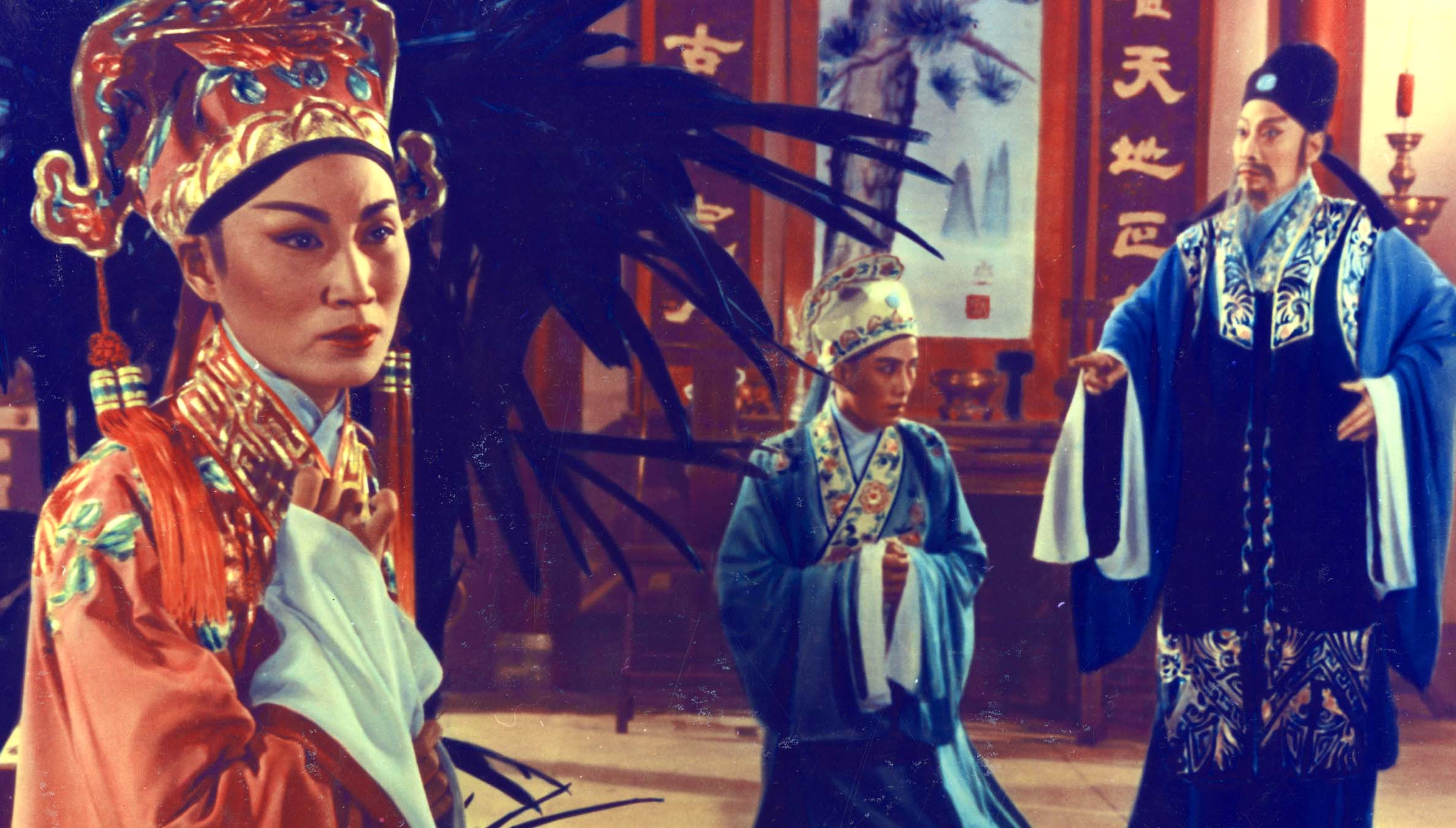
The Lost Kite (2K Digitised Version)
Dir: Xu Tao
Prod Co: Shanghai Film Studio
Cast: Ma Si-tsang, Hung Sin Nui, Li Cuifang, Li Feilong, He Jianqiu, Liu Meiqing
1957 | Colour | DCP | Cantonese | Chi & Eng Subtitles | 125min
A poem written on a broken kite by scholar Zhang (Li Feilong) leads to a romantic encounter with maidservant Cuilian (Hung Sin Nui), but also a misunderstanding by Cuilian’s mistress, the Magistrate’s wife (Li Cuifang), who accuses her of improper conduct. Beaten and locked up, Cuilian narrowly escapes a forced marriage when she is rescued by Qiuxiang (Liu Meiqing), another maidservant. She is taken under the wing of schoolmaster Xie Bao (Ma Si-tsang) and reunites with her beloved. When the Magistrate demands to search the school, Xie outfoxes the officials, allowing the lovers to escape and finally unite in marriage.
The Lost Kite was originally a folk tale from Hainan Island, and was first performed as a Qiong opera in the 19th century. It was adapted into a Cantonese opera in 1954 by librettist Yang Zijing, starring Liu Guorong, Liu Meiqing and Li Feilong. Its libretto was further refined the next year, introducing key scenes and also establishing Ma Si-tsang and Hung Sin Nui firmly as co-leads. Performing for the first time the role of an elderly character (laosheng), Ma changes his signature ‘beggar-style tone’ into something deeper and more sophisticated. As a result, his vocal chemistry with Hung Sin Nui reaches new heights. Ma, Hung Sin Nui, and the Guangdong Cantonese Opera Troupe performed The Lost Kite in Beijing in May 1956 to critical acclaim. The same year, it was made into a film by Shanghai Film Studio, which premiered in Hong Kong in October 1957 and broke records by selling over 600,000 tickets in two weeks.
| Date | Time | Venue |
|---|---|---|
| 19/9/2026 (Sat) # | 2:30pm | Cinema, Hong Kong Film Archive |
The contents of the programme do not represent the views of the presenter. The presenter reserves the right to change the programme should unavoidable circumstances make it necessary.