

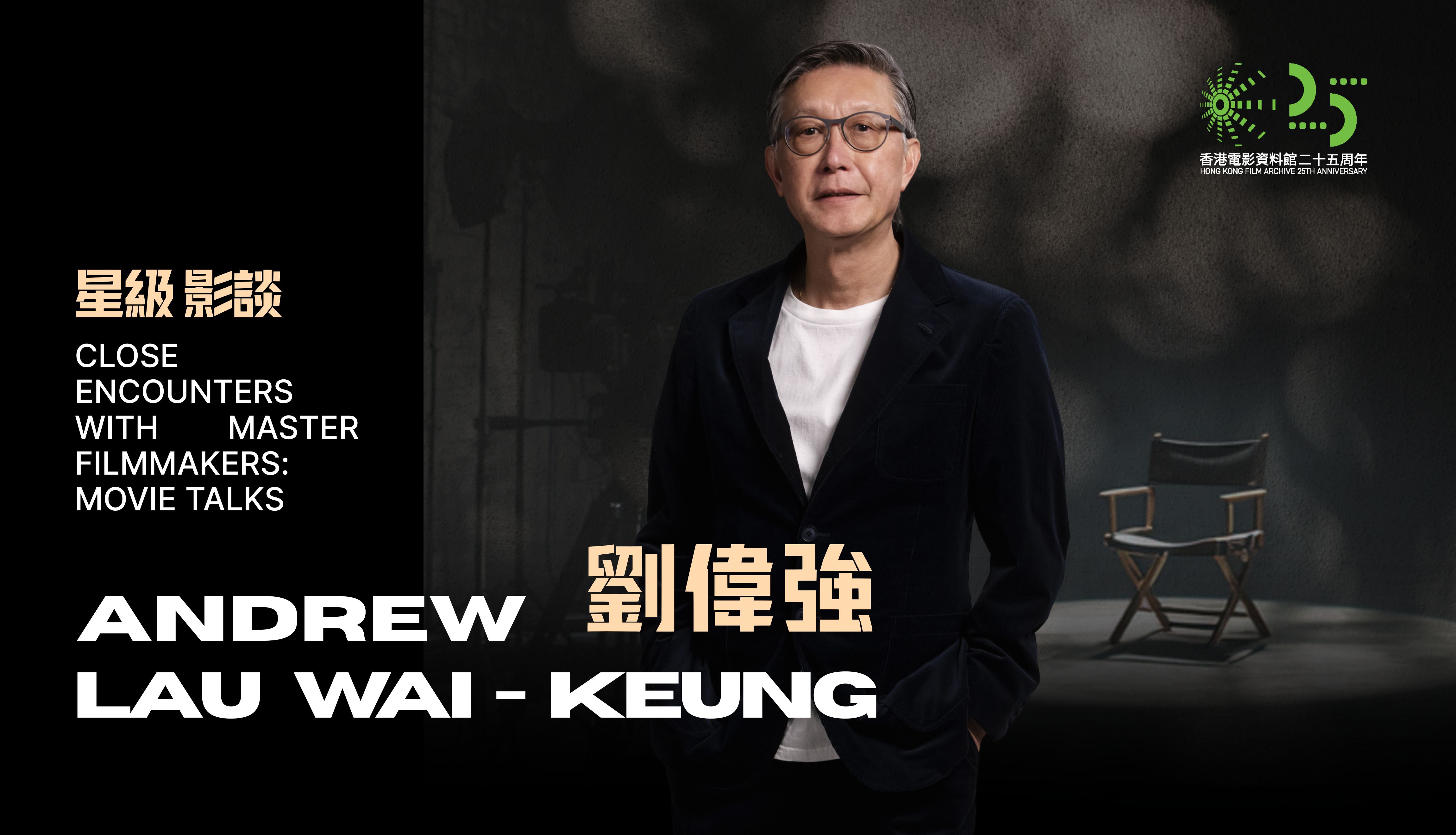
To celebrate its 25th anniversary, the Hong Kong Film Archive is presenting three editions of ‘Close Encounters with Master Filmmakers—Movie Talks’ series this year. Each edition is curated by a Hong Kong Film Awards-winning director, who personally selects the films and plans the programme. The second edition looks back on the filmmaking career of Andrew Lau Wai-keung.
Andrew Lau developed an interest in photography from a young age and began taking pictures with his father’s camera when he was still a child. After graduating from secondary school, he joined Shaw Brothers as a production assistant in June 1981, later requesting a transfer to the camera department. The first film he worked on was Lau Kar-leung's Legendary Weapons of China (1982). He initially served as a camera loader under cinematographer Peter Ngor, before being promoted to camera assistant.
A classic example of a self-made man, Lau spent his early years on set, observing the working methods of leading directors and studying lighting design and cinematography. He also watched a lot of Shaw Brothers’ raw footage, read books on cinematography, and learnt from colleagues across different departments. This period provides him with a solid grounding in filmmaking and cinematography, with Shaw Brothers effectively becoming his own ‘Shaolin Temple’, where he honed his filmmaking skills. During the production of Mr. Vampire (1985), the original cinematographer, Peter Ngor, left the crew to work on other projects. Director Ricky Lau Koon-wai and action choreographer Lam Ching-ying decided to let Andrew Lau to take over as cinematographer, marking the beginning of a new chapter in his creative career.
Lau was known for his flexible approach, he was constantly learning through practice and never felt bound by convention. Beginning with his debut as cinematographer on Ricky Lau Koon-wai and Philip Chan's Where's Officer Tuba? (1986), and continuing with Ringo Lam's City on Fire (1987) and Wong Kar-wai’s As Tears Go By (1988), Andrew Lau adopted a handheld shooting style and made bold use of Fuji's newly developed high-speed film stock. The resulting images were dynamic and refreshing. His vivid and atmospheric portrayal of Hong Kong's urban nightscape, in particular, became a defining visual element in the films of both Ringo Lam and Wong Kar-wai, quickly establishing Lau as one of the leading cinematographers among the new generation.
Lau rose from production assistant to one of the industry’s most promising cinematographers in just seven years. This was undoubtedly made possible by the unprecedented boom in Hong Kong’s film industry during the 1980s, when studios such as Shaw Brothers, Golden Harvest, Cinema City and D & B Films were producing a wealth of films and nurturing a new generation of filmmakers. But Lau's adaptability, technical expertise and ability to seize opportunities for further development were also crucial factors in his rapid rise.
After years of practical experience, Lau made his directorial debut with Against All (1990), produced by Danny Lee’s Magnum Films. The film marked the beginning of his dual career as a director and cinematographer. Over the next five years, he worked across a remarkable range of genres, including action, science fiction, comedy, horror and erotic films. In 1995, he co-founded BoB and Partners Company with Wong Jing and Manfred Wong. Their early productions, the Young and Dangerous series (1996–1998), adapted from Cowman's comic series, combined youth films with the triad genre and introduced new screen idols such as Ekin Cheng. Their youthful energy, raw intensity and fast-paced productions made a strong impression on the industry. Produced quickly, to a high standard and with great commercial success, the Young and Dangerous series firmly established Lau as one of Hong Kong's leading commercial directors and marked the most important turning point in his directing career.
As a director, Lau is renowned for his willingness to break new ground and his ability to solve creative and technical challenges. The Stormriders (1998), Lau’s adaptation of Ma Wing-shing's comic series, pioneered the integration of computer-generated visual effects with Hong Kong comic-book aesthetics. He later founded Basic Pictures, and together with Alan Mak and Felix Chong, co-wrote and co-directed Infernal Affairs (2002), which reinvented the undercover crime thriller. The film was later remade by Martin Scorsese into The Departed (2006). With Initial D (2005), adapted from a Japanese manga series, Lau ventured into the topic of motor-racing, boldly casting Hong Kong actors in the principal Japanese roles and using the conventions of commercial cinema to transcend cultural boundaries.
Lau subsequently expanded his career into international and Chinese mainland markets. His later works include Korean film Daisy (2006), Hollywood productions The Flock (2007) and Revenge of the Green Dragons (2014), as well as major Chinese Mainland productions such as The Founding of an Army (2017), The Captain (2019) and The Dumpling Queen (2025).
Andrew Lau has distinguished himself among Hong Kong's commercial filmmakers through his outstanding craftsmanship. His commitment to continuous learning, refinement of his craft and embrace of new challenges has resulted in a body of influential and enduring work. This edition of ‘Close Encounters with Master Filmmakers: Movie Talks’ presents six key films from across his career. Andrew Lau will also appear in person at the screenings to look back on his legendary filmmaking journey with the audience.